My Research Topics
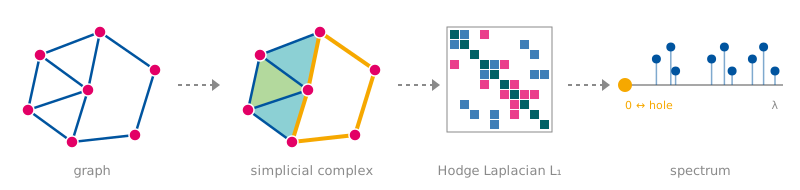
On the high level, I work on Numerical Methods for Data Science; in the recent years I focus specifically on the intersection of numerical (randomized) linear algebra and network science: I design efficient and provable algorithms for the matrices associated with graphs and their higher-order generalizations, such as simplicial complexes (using Hodge Laplacian operators), and operators used for in graph signal processing (graph filters). I am currently part of the Computational Network Science group of Michael Schaub at RWTH Aachen.
Higher-order networks
Simplicial complexes allow to model polyadic interactions, but the Hodge Laplacians that describe them are large, ill-conditioned and expensive to work with. My PhD thesis, Topological Instability and Preconditioning of Higher-Order Laplacian Operators on Simplicial Complexes, tackled this from two sides. The first question was how stable the topology is: I suggested to reduce the problem of searching for the smallest perturbation that changes a homology group as a spectral matrix nearness problem and solved it with a bilevel gradient-flow method (J. Sci. Comput., 2023). The second part addressed quicker linear system solutions with these operators: I built a Cholesky-like preconditioner from a heavy collapsible subcomplex (SIMAX, 2024). This work brought me to the notion of sparsification of simplicial complexes using local densities of states (SIMODS, 2026) which allows to reduce simplicial complex to a sparser, more computationally efficient one at any order with great computational complexity.
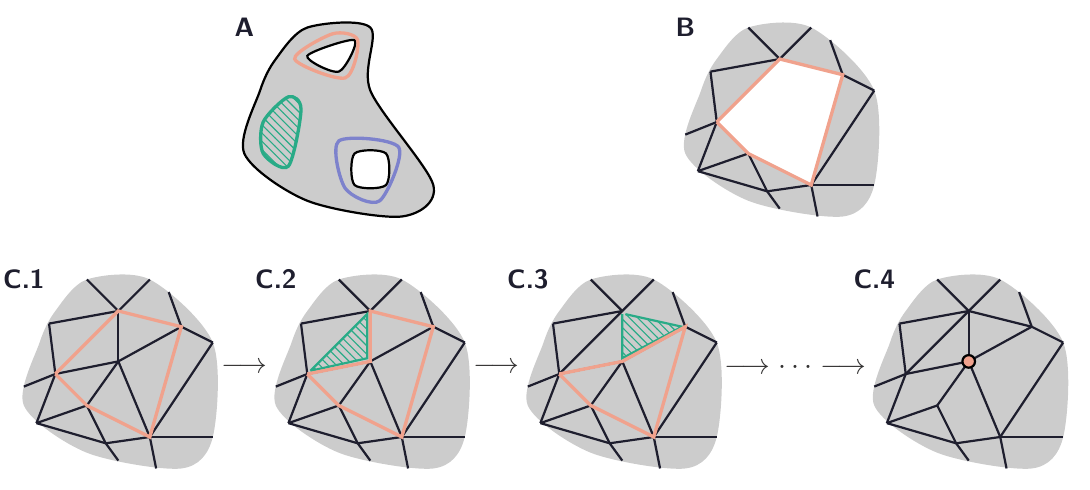
Homology counts holes: cycles around a hole (A, B) cannot be filled, others contract by sweeping over triangles (C.1–C.4). From my PhD thesis.
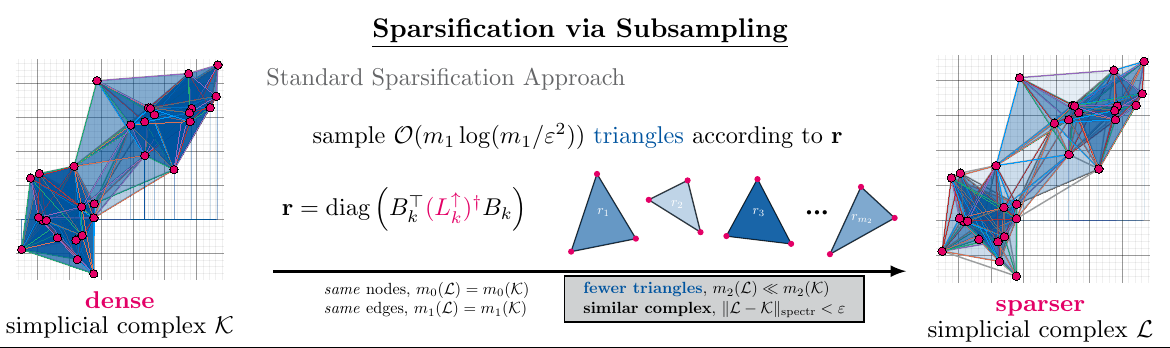
Spectral sparsification: keep the nodes and edges, sample far fewer triangles, stay spectrally close. From arXiv:2502.07558.
Learning Algorithms through the Computational Lense
I aim to bring similar matrix-analytic tools to machine learning. This includes exploiting contractivity of neural ODEs as an eigenvalue optimization problem (Math. Comp., 2025) for stabilisation, convergence of gradient descent/flow for linear GNNs (preprint, 2025), and Riemannian interpolation of low-rank graph filters on the Grassmann manifold for parametric graph families (preprint, 2025).
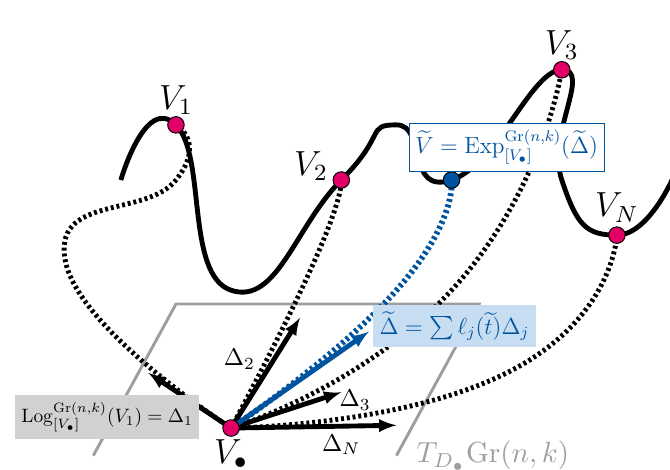
Interpolating graph filters on the Grassmann manifold: map to a tangent space, interpolate, map back. From arXiv:2510.23235.
Coupled oscillators
Earlier, I worked on inverse problems for Kuramoto and Van der Pol models of coupled oscillators, with applications to synchronization in solar activity (Physica D 2020, 2024; CNSNS 2020; Entropy 2020).
Going forward, I want to make linear algebra for higher-order and evolving networks scalable and structure-aware. That means exploiting topology to build faster solvers, sparsifiers and filters, and connecting them to learning on relational data.
If any of this overlaps with your work, get in touch!